
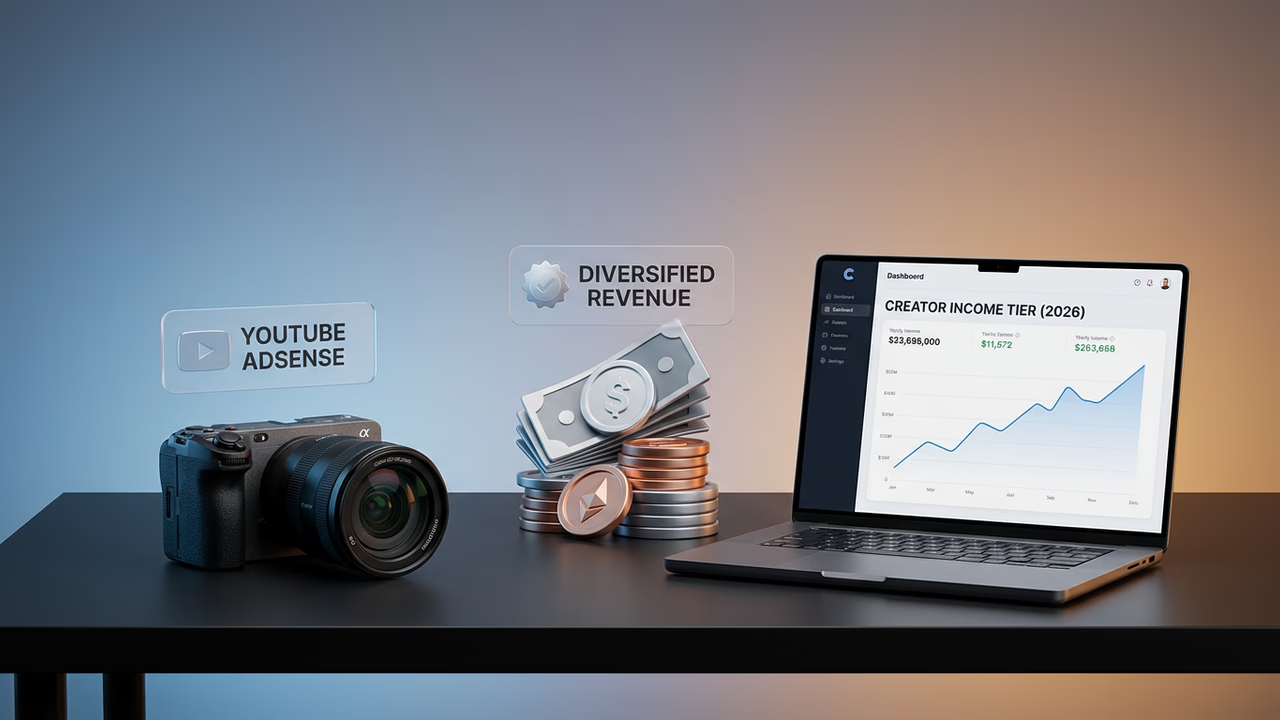
Annual YouTube Earnings at Every Channel Size
YouTube income scales with both channel size and revenue stream diversification. AdSense alone rarely sustains a full-time income until channels reach 500K+ subscribers in most niches. Creators who add sponsorships, affiliate income, and memberships can reach full-time income much earlier, sometimes at 50,000–100,000 subscribers in high-RPM niches.
What Annual AdSense Income Looks Like by Subscriber Tier
AdSense income is driven by monthly views, not subscriber count directly. These estimates assume consistent monthly uploads and US-heavy audiences:
- 1,000–10,000 subscribers: $100–$2,000/year (new channels, inconsistent posting, low views)
- 10,000–50,000 subscribers: $1,000–$8,000/year ($3–$5 RPM, 30K–150K monthly views)
- 50,000–100,000 subscribers: $3,000–$15,000/year (100K–300K monthly views)
- 100,000–500,000 subscribers: $8,000–$40,000/year AdSense (varies heavily by niche)
- 500,000–1,000,000 subscribers: $20,000–$100,000/year AdSense (Finance channels up to $300K)
- 1,000,000+ subscribers: $50,000–$500,000+/year AdSense (niche-dependent)
Related Reading
How Much Does YouTube Pay for 1 Million Views?
The per-million-view payout by niche: the monthly milestone that drives annual AdSense estimates.
YouTube Earnings Per 1,000 Views
The complete 2026 RPM breakdown by niche: the number that scales your annual income projection.
Personal Finance YouTube RPM
Why Finance creators at 100K subs out-earn Gaming creators at 1M subs, with RPM data.
How Niche Determines Annual Income More Than Subscribers
Two channels with identical subscriber counts can have 10× different annual incomes based purely on niche. A Finance channel with 200,000 subscribers typically earns more per year than a Gaming channel with 1,000,000 subscribers, because the Finance channel generates $15–$40 RPM versus $2–$5 RPM. See personal finance YouTube RPM and gaming channel RPM side by side to quantify the gap.
This is the most important factor for aspiring creators to understand when projecting how much youtubers make a year. Choose your content direction before you build a revenue model. The difference compounds over time.
How Sponsorships Change the Annual Income Math
Sponsorships are the income stream that most dramatically changes what youtubers make a year. Ad deals typically pay $1,000–$5,000 per integration at 100K subscribers, and $10,000–$50,000+ per integration at 1M+ subscribers. A mid-tier creator doing one sponsorship per month doubles or triples their AdSense income without any increase in views.
What Full-Time YouTube Income Requires
The full-time income threshold on YouTube is typically defined as matching or exceeding a local median salary. In the US, that is approximately $55,000–$65,000/year. Here is what is generally required to reach that level:
- AdSense-only path: 2M–4M monthly views at average RPM ($3–$5), or 500K–1M monthly views in Finance/Tech niches
- AdSense + sponsorships: 200K–500K monthly views plus 1–3 brand deals per month
- Diversified income (ads + affiliates + memberships + products): possible at 50,000–150,000 subscribers in high-intent niches
- YouTube Shorts-only: not viable as a primary income source. Shorts RPMs are too low.
What the Top YouTubers Make Per Year
The highest-earning YouTubers derive the majority of their income from sources beyond AdSense. MrBeast earned an estimated $85M+ in 2024 — primarily from his food business, merchandise, and brand deals rather than ad revenue. MKBHD (Marques Brownlee) earns approximately 60% of his income from sponsorships. These figures are outliers, but they illustrate the ceiling that content-to-product pipelines can reach.
YouTube Shorts Annual Earnings vs Long-Form
A channel generating 100 million Shorts views per year earns approximately $3,000–$8,000 from those Shorts. The same channel generating 10 million long-form views per year earns $30,000–$50,000 at average RPM, more than 4× as much from one-tenth the views. Annual planning should treat Shorts as a subscriber acquisition channel, not an income channel.
How Seasonality Affects Annual YouTube Revenue
YouTube income is not evenly distributed across the year. Q4 (October–December) accounts for a disproportionate share of annual AdSense revenue as brands compete for ad slots ahead of the holiday season. Q1 is the weakest quarter: CPMs can fall 30–50% from Q4 peaks. A creator who earns $5,000/month in November may earn $2,500/month in January, even with identical view counts. Track seasonal RPM shifts in YouTube Studio's Revenue analytics to plan your content calendar around the highest-earning months. You can also use the projected RPM guide to model quarterly fluctuations before they happen.
Estimate Your Annual YouTube Income
Enter your monthly views, niche, and location. See a monthly and annual earnings estimate based on 2026 RPM data.
Use the YouTube Earnings CalculatorBuilding to $100K/Year on YouTube — What It Actually Takes
Reaching $100,000/year on YouTube requires one of three paths: (1) very high view volume in average niches (2M+ monthly views), (2) moderate view volume in premium niches (300K–500K monthly views in Finance/Tech), or (3) lower view volume with strong sponsorship pipeline (100K–200K monthly views plus consistent brand deals). The third path is how most full-time creators actually cross $100K. Not by chasing view counts, but by building relationships with advertisers in their niche.
Frequently Asked Questions
How much does a YouTuber with 1 million subscribers make per year?▾
How much do small YouTubers make (1,000–10,000 subscribers)?▾
How much do YouTubers make from Shorts per year?▾
What is the average RPM on YouTube?▾
How much can you make on YouTube with 100K subscribers?▾
How much do you need to make money on YouTube?▾
See What Your Channel Could Earn This Year
Our calculator estimates annual YouTube income based on your monthly views, niche, and location, with realistic ranges, not inflated averages.
Calculate YouTube Revenue