
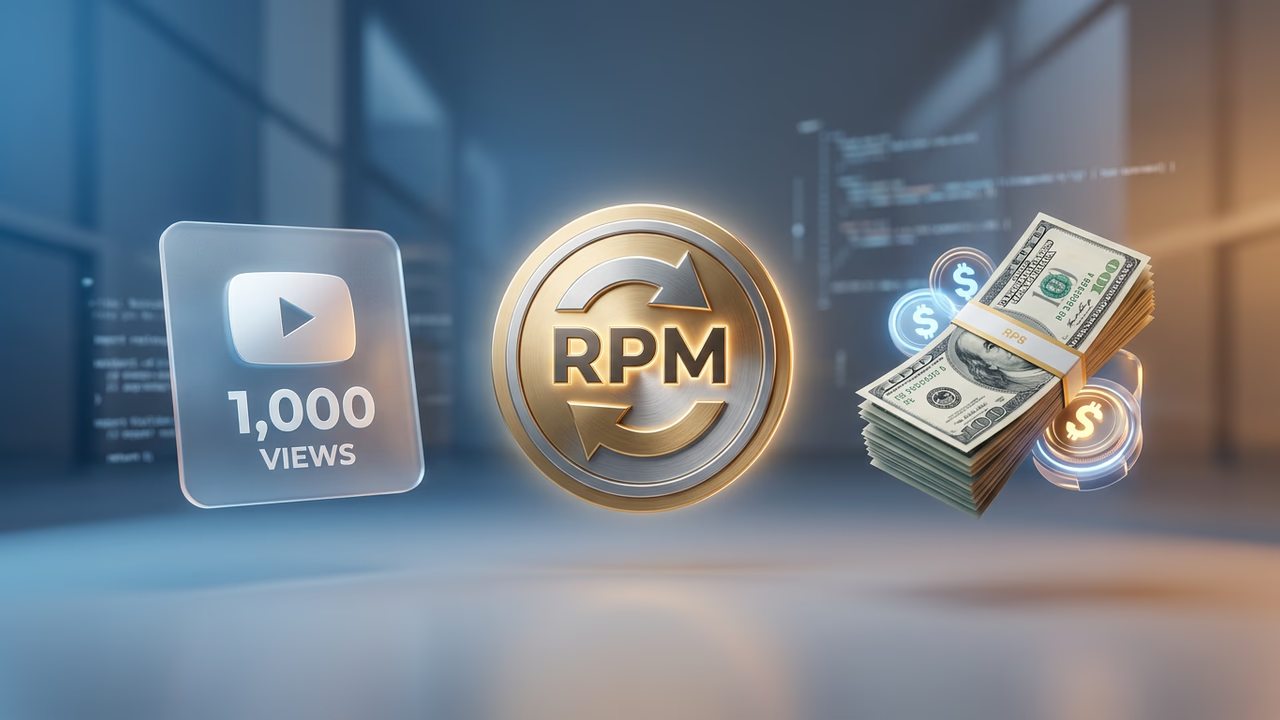
How YouTube Converts Views Into Money
YouTube does not pay for views directly. It pays for ad impressions that occur during those views. The metric that captures this conversion is RPM (Revenue Per Mille): your earnings per 1,000 video views after YouTube keeps its 45% cut of ad revenue. When people search "youtube views to money," RPM is the conversion rate they are looking for. Understanding the distinction between RPM and CPM is covered in detail in the YouTube RPM vs CPM explained guide.
Not every view produces an ad impression. Viewers using ad blockers, those who skip ads immediately, and YouTube Premium subscribers contribute views without generating ad revenue. In practice, 30–70% of your total views result in monetised ad impressions — which is why RPM reflects actual deposited income rather than gross advertiser spend.
The Views-to-Money Formula
The calculation is straightforward: multiply your monthly view count by your RPM, then divide by 1,000. A Gaming channel with 500,000 monthly views at $3 RPM earns $1,500/month. A Personal Finance channel with the same 500,000 views at $20 RPM earns $10,000/month. Same views, different conversion rate, 6.7× difference in income.
Related Reading
How Much Does YouTube Pay for 1 Million Views?
The full 2026 niche-by-niche breakdown for the 1 million view milestone, from $1,000 for entertainment to $40,000 for finance.
How Much Do YouTubers Make a Year?
Annual income at every subscriber tier: what the views-to-money rate means for full-year earnings.
YouTube Earnings by Location
How your audience country multiplies or divides your views-to-money conversion rate, with country-by-country data.
How Many Views Do You Need to Earn $100, $1,000, $10,000 a Month
The view count required to hit a monthly income target varies enormously by niche. A Finance creator needs 40× fewer views than an Entertainment creator to earn the same monthly income:
- To earn $100/month at $2 RPM (Entertainment): 50,000 views/month
- To earn $100/month at $5 RPM (Average): 20,000 views/month
- To earn $100/month at $20 RPM (Finance): 5,000 views/month
- To earn $1,000/month at $2 RPM: 500,000 views/month
- To earn $1,000/month at $5 RPM: 200,000 views/month
- To earn $1,000/month at $20 RPM: 50,000 views/month
- To earn $10,000/month at $5 RPM: 2,000,000 views/month
- To earn $10,000/month at $20 RPM: 500,000 views/month
Views to Money by Niche: 2026 Conversion Rates
Here is the youtube views to money conversion rate for each major niche, expressed as RPM (earnings per 1,000 views) for a US-based audience watching long-form content:
- Personal Finance & Investing: $12–$40 RPM. Highest advertiser demand, premium CPMs.
- Business & Marketing: $8–$25 RPM. B2B advertisers, high customer lifetime value.
- Technology & Software: $5–$15 RPM. SaaS and consumer tech brand spend.
- Health & Fitness: $3–$8 RPM. Supplement and wellness advertisers.
- Education: $3–$10 RPM. E-learning and professional development brands.
- Food & Cooking: $2.5–$7 RPM. FMCG advertisers, lower purchase intent signals.
- Travel & Lifestyle: $1–$5 RPM. Variable CPMs, seasonal peaks in Q4.
- Gaming: $2–$5 RPM. Large audience, lower advertiser spend per impression.
- Comedy & Entertainment: $2.50–$5 RPM. Entertainment niche, mid-tier advertiser demand.
How Audience Location Changes Your Conversion Rate
The same number of views from different countries produces dramatically different income. US viewers are worth roughly 4× Indian viewers to an advertiser. If your audience is geographically diverse, your blended RPM will be lower than the niche baseline suggests. The earnings by location guide covers every major market with exact multipliers. YouTube Studio's Revenue tab breaks down your RPM by geography once your channel is monetised.
- United States: baseline (1.0×). Highest CPMs globally.
- United Kingdom: ~0.70×. Second-highest English-language market.
- Canada: ~0.90×. Strong second English market.
- Australia: ~1.15×. Highest CPM in English-speaking markets.
- Germany & France: ~0.60×. Solid European ad markets.
- Brazil & Mexico: ~0.30×. Large audiences, lower CPMs.
- India: ~0.025×. Massive audience, fraction of US CPM value.
YouTube Shorts Views Convert Differently
Shorts views and long-form views are not equivalent in the views-to-money conversion. A Shorts view converts at approximately $0.03–$0.08 per 1,000 views — 50–100× less than long-form. Shorts ads are pooled across all creators and distributed differently than standard AdSense, which compresses the per-view rate significantly.
Why Views and Earnings Do Not Move at the Same Rate
A video that doubles its views does not always double its earnings. Viral videos often attract lower-CPM international audiences that dilute your blended RPM. A video published in January earns less per view than the same traffic in November due to seasonal CPM swings. Ad engagement rates vary by content type even when view counts are identical.
This is why creators who track only view counts get surprised when their AdSense does not reflect their growth. The views-to-money conversion rate is dynamic; it changes based on when, where, and how people watch. For perspective on what 1 million views ultimately pays, see YouTube pay for 1 million views.
Calculate Your Exact Views-to-Money Rate
Enter your monthly views, niche, and audience location. Get a personalised RPM and earnings estimate in seconds.
Use the YouTube Earning CalculatorCommon Myths About YouTube Views and Money
- Myth: More views always means more money. Reality: A smaller Finance channel regularly out-earns a larger Gaming channel. RPM matters more than raw view volume.
- Myth: You get paid for every view. Reality: Ad-blocked, skipped-ad, and Premium views generate no direct ad revenue.
- Myth: YouTube Shorts pay the same as regular videos. Reality: Shorts pay 50–100× less per 1,000 views.
- Myth: Earnings grow proportionally with subscriber count. Reality: Earnings depend on views × RPM, not subscriber count.
- Myth: Viral videos make the most money. Reality: Viral videos often attract low-RPM broad audiences. High-intent niche content frequently earns more per view.
Frequently Asked Questions
How many YouTube views do you need to make $1,000?▾
How do I convert YouTube views to money?▾
What is a good CPM on YouTube?▾
How much does YouTube Shorts pay per million views?▾
How much does YouTube take from ad revenue?▾
How much is 1 million views on YouTube worth?▾
See Your Views-to-Money Estimate
Our YouTube calculator uses niche-specific RPM data to turn your view count into an accurate earnings range, not a generic average.
Calculate YouTube Revenue