
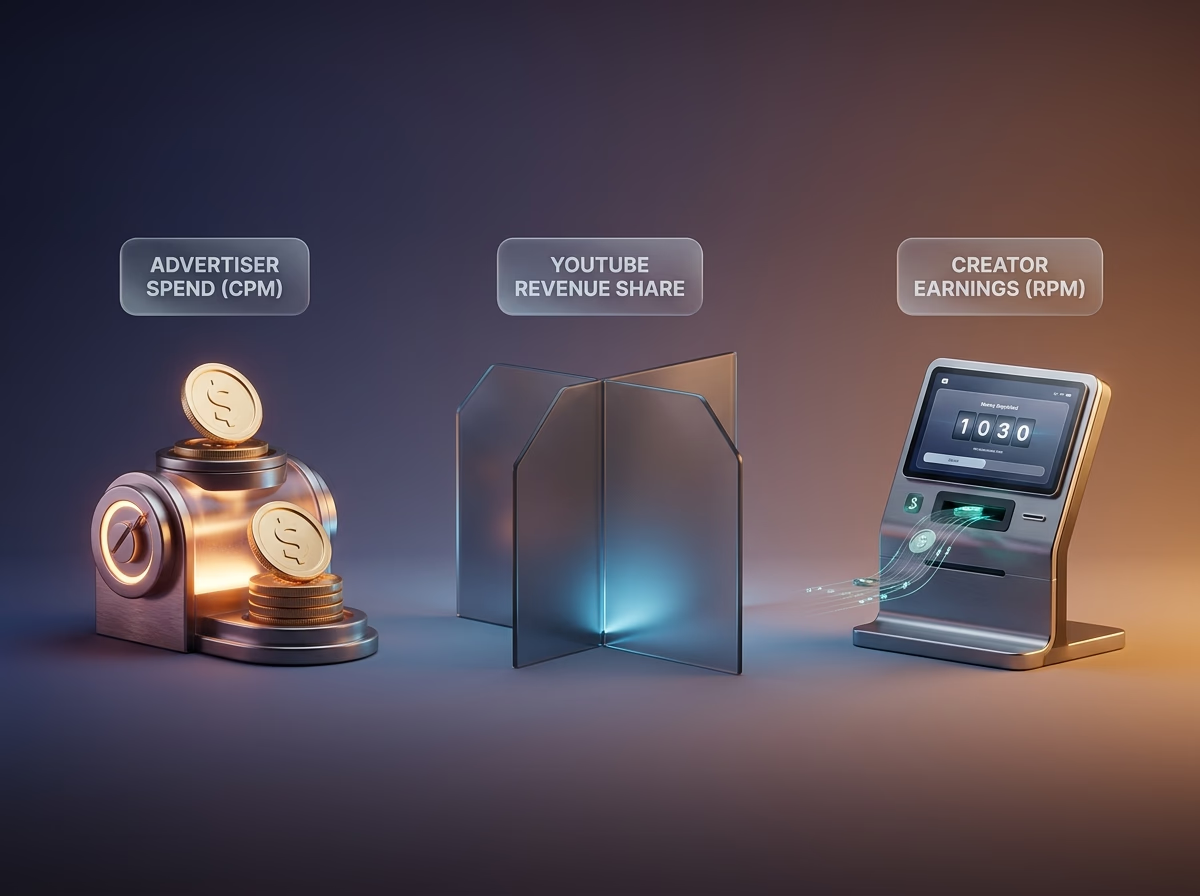
Why the gap is bigger than you think
When a brand runs a $10 CPM campaign on YouTube, they're paying $10 for every 1,000 ad impressions served. But here's what most creators miss: not every video view has an ad. Skipped ads, ad-blocked viewers, and YouTube's own ad inventory decisions mean that only a fraction of your views are "monetized views." YouTube then takes 45% of the revenue from those monetized views before any of it reaches you. This is why YouTube earnings per 1,000 views can look so different from the CPM figures creators cite online.
The formula
RPM = (Total Estimated Revenue ÷ Total Video Views) × 1,000. This is the number you should care about. It accounts for the YouTube cut, the monetization rate, and all revenue sources: AdSense, YouTube Premium, Super Chats, and channel memberships, divided across all your views. YouTube Studio's Revenue analytics tab is where you find your actual RPM once your channel is monetised.
Why niche changes everything
Advertisers don't pay the same CPM for all content. A Personal Finance video commands premium ad rates because viewers are actively thinking about money (a finance advertiser's dream audience). A Gaming video commands a fraction of that, because the intent signal is entertainment, not purchase. The difference is not subtle:
- Personal Finance: $15–$30 RPM (US audience, long-form)
- Tech Reviews: $10–$20 RPM
- Health & Fitness: $5–$11 RPM
- Food & Cooking: $3–$7 RPM
- Gaming: $2–$5 RPM
- Comedy / Entertainment: $2.50–$5 RPM
A Personal Finance creator with 500,000 monthly views can out-earn a Gaming creator with 5,000,000 monthly views. The channel with 10× fewer views makes more money. This is the single most important fact aspiring creators misunderstand. See personal finance YouTube RPM and gaming YouTube RPM side by side to see just how wide that gap is.
Location multiplies (or divides) your rate
Advertisers pay drastically different rates depending on where your viewers are. US-based viewers generate the highest ad rates because that's where the most advertising budget is concentrated. Here's a rough multiplier table relative to a US baseline:
- United States: 1.0× (baseline)
- United Kingdom: ~0.70×
- Canada: ~0.90×
- Australia: ~1.15×
- India: ~0.025×
- Global Average: ~0.55×
A US-based Personal Finance audience might earn $20 RPM. The same content with a predominantly Indian audience might earn $5 RPM. This is why growing an audience in high-CPM markets (through English-language content, US-centric topics, or platform-level targeting) has a direct, measurable impact on earnings. For a full country-by-country breakdown, see YouTube earnings by location.
Related Reading
YouTube Earnings Per 1,000 Views
The complete 2026 RPM breakdown by niche, and why the generic "$3–$5" figure you see everywhere is misleading.
YouTube Views to Money
The exact views-to-money conversion rate for every major niche, with a formula you can apply to your own channel.
YouTube Earnings by Location
How your audience geography multiplies or divides your RPM, with specific country multipliers.
Real-world validation: what creators actually disclose
Most RPM discussions are speculative. But a handful of creators have publicly shared their actual AdSense dashboards:
The Shorts number is particularly important. Many new creators build their channel on Shorts because the algorithm rewards them with reach. But a Shorts RPM of $0.027 means you need 37 million Shorts views to earn what a long-form Personal Finance video earns at 100,000 views. Use a YouTube Shorts earnings calculator to model your own numbers. Google's AdSense payment overview explains how revenue is deposited once it clears the payout threshold. Shorts can build an audience; they are not a monetization strategy.
What to do with this information
Before you commit to a niche, content format, or posting strategy, run the numbers. It takes under 2 minutes and it'll tell you whether your plan is viable before you spend 6 months finding out the hard way. Understanding annual YouTube earnings at different channel sizes puts your RPM figure in a real income context.
See your exact RPM estimate
Enter your niche, audience location, and monthly views. Get a realistic min–max earnings range based on real RPM data, free, no signup required.
Try the YouTube CalculatorThe bottom line
CPM is the advertiser's number. RPM is yours. When someone asks "how much does YouTube pay," the honest answer is: it depends entirely on your niche, your audience's location, your content format, and what time of year it is. The range between the worst-case and best-case scenario is not 10% — it's 10×. If you want a precise figure for your setup, see projected RPM on YouTube to model your channel's likely rate before you build your content strategy around a revenue assumption.